Saturday, January 26, 2019

Archetype Archive: Ninjas

The Tsukikage with Yamigitsune's mask is the best

Now that I have about a month long window before the next two set comes out (Golden Garga and Violence Vanity), I figured it was time I started my Archetype Archive posts. I'll be doing all the Katana World archetypes but these posts take some time so bear with me.

The different archetypes of Katana World have had some interesting game play changes over the course of the seasons. I hope to document these play style changes for several reasons.

First, players can understand the past play styles of a certain deck. If they like an older play style, they will know what key cards to look for to build the deck. Even if it's not a tier 1 deck. For example, one weekend, I made a season 1, size 1 ninja deck that revolved around countering the opponent's deck. It wasn't a great deck but it was fun for me to try to predict what my opponent would play.

Second, this page will be a good summary page for players to understand an archetype as a whole to gauge if they have any interest in an archetype. Rather than reading tens or possibly hundreds of individual cards, trying to link card's effects with each other and determining if it's even fun to build and play.

Third, at the time of writing this, we are going on our fifth year of the game being out. It's hard for newer players to read up and research decks from past years to get a grasp of where this game started and where it is now. I personally am this kind of person. When I get into a topic, I want the full history of where it started and how it got to where it it now.

Keep in mind that I will be mainly mentioning key cards for the deck. In this case are Ninjas and Ninja Art attributes. I will not be talking about literally every card in a set either. That will be just too tedious and defeat the point of this article being about a summation of the archetype over the course of the years. Other cards will be talked about that relate to their specific attribute.

Buddyfight: Season 1


Ninjas were probably the most complex deck for a while. The deck has to shift its tech cards depending on what deck the opponent was playing. Ninjas are all about predicting the opponent's moves and countering them while also inflicting damage. This play style made the opponent play in strange and often times, inefficient ways. It some situations, the opponent couldn't play a card for fear of losing the game.

I've got the power of god and anime on my side!

This was usually done with the impact Secret Sword, Lethal Formation. With Lethal Formation, the player would place a card from their hand, deck or drop underneath during their final phase in prediction to counter the opponent during their turn. Even though any card could go underneath, players would put other "Secret Sword" cards underneath Secret Sword, Lethal Formation. These "Secret Sword" cards could only be activated from underneath Secret Sword, Lethal Formation. Keep in mind as well that grabbing a card from the deck helped thin the deck to increase your own odds of drawing what the player needed.

There were initially 3 "Secret Sword" impacts to counter the opponent. They were Moon Fang, Shooting Star, and Star Crusher. The impacts were very expensive. All three costed 3 gauge but Clear Serenity was a solid card with counter to gain enough gauge to play any of the "Secret Swords".

Nin!
The main ninja for the deck was Nanomachine Ninja, Tsukikage. He also is Zanya Kisaragi's buddy monster in the anime. He was the go to monster to use in ninjas. He was free to call with slightly above average stats. His optional ability "Nanomachine Body Replacement" allowed him to remain on the field by discarding a non-monster card when he would be destroyed.

There are many spell cards in Katana World that can counter specific actions but if the situation didn't arise that a card could be used, the player could always discard a useless card to keep Tsukikage on the field. There was a real art to determining if a player should keep Tsukikage a live or let him finally perish.

Electron Ninja, Shiden is another staple for the deck. As the game has progressed over the years, Shiden has never been obsolete. His ability "Cyber Analysis" allowed the player to discard a "Ninja Arts" card from their hand and pay one gauge to draw two cards. Since the non-Secret Sword, Lethal Formation impact cards were dead cards in the player's hand, Shiden allowed those dead cards to essentially becomes a Nice One! clone.

Since Secret Sword, Lethal Formation can grab the other "Secret Sword" impacts from drop, the impacts were fine being discarded. This was a double edge sword though. The opponent could see what "Secret Sword" that was put to drop but now they know what they have to deal with during their turn if it was retrieved with Secret Sword, Lethal Formation.

Shinobi Scrolls added a lot of utility for the deck. Players could put a Ninja Arts that they know will be used for its full effect underneath Shinobi Scrolls, pay one gauge and draw a new card. Then, they could use it when the time was right on the opponent. Or, if the player needed more non-monster cards for Tsukikage's ability, they could sacrifice a monster card from their hand, pay a gauge and hope to draw into what they needed. Shinobi Scroll's ability is a soft once per turn. Meaning its ability could be used once per copy of Shinobi Scrolls on the field.

The Immortal Entities set released only a handful of Ninja related cards but one of them is still used to this day. Ninja-Arts, Half-kill will always be a nice tech option as long as monsters have soulguard which, as this game has progressed, has proven to always be true.

Set 3, Drum's Adventure, had some new Ninja cards that supported a different play style than what I've talked about above. It's been colloquially named Burn Ninjas and hasn't gained much support. The main monster cards were Fire Streak Ninja, Gokuen, Sniping Ninja, Yoichi and Sky Ninja, Yamigarasu. Yamigarasu was the buddy of Shusui Kanahebi; the player of this deck.
Ka Kaw!

The main field set up was Gokuen in the center with Yoichi and Yamigarasu on either side in the left and right spaces. The concept was to burn the opponent every time the monsters on the left and right wanted to rest (mainly through attacking). Then, Gokuen would use his "Flame Barrier" ability to gain 3,000 defense. Gaining a total of 8,000 defense. The card itself says 4,000 defense but it was an error and should be 3,000. This was very high defense back in season 1 and made it hard for people to get over Gokuen. Flame Barrier was not once per turn either so if the opponent did get to 8,000 or higher, the player could always discard another card to bump the defense to 11,000.

The spells meant for this deck to function were Final Showdown at the Great Gojo Bridge, Dark Ninja Technique, Poison Mist Formation and Ninja Arts, Snake Gaze.

Gojo Bridge was meant to keep Yoichi and Yamigarasu on the sides from being attacked while forcing the opponent to attack Gokuen. Poison Mist Formation was meant to be a slow burn that made the opponent have to battle against time. Snake Gaze was meant to slow the opponent's battle phase by resting a monster while at the same time still burning the opponent.

Out of these three, Snake Gaze has actually still seen game play to this day since is prevents double, triple, etc attack skills from going off. Gojo Bridge and Poison Mist are too expensive at 2 gauge and Poison Mist's burn was super slow as well.

Unfortunately, even to this day, the Burn Ninja deck didn't get any direct support after it came out which made it feel like a filler deck. Especially since none of the above mentioned cards have ever had a new version or a retrain. It's a shame considering this deck was super slow and I felt had some potential but in Bushiroad's eyes, it may have been a "poor man's" ninja deck. Plus, Bushiroad may have been cautious about having too much burn in the game and may have wanted to limit burn as a play style.
What getting the squad together feels like

The last main set of season 1, Break to the Future, helped only expand the number of counter options for ninjas. Super Lethal Formation was released in this set which has still not been used as much as normal Secret Sword, Lethal Formation because of the one gauge in the cast cost. The extra 1,000 power and 1,000 defense to all ninjas just can't be justified for a gauge. Especially since all the counter secret sword impacts costed 3 gauge. That is 4 gauge the player needed for everything to go off and it just wasn't worth it. The one gauge was the breaking point because even Clear Serenity couldn't give the player everything they needed for this to go off.

Three new ones were released as well in Break to the Future. These were Secret Sword, Comet, Morning Star and Glittering Star. Unlike the original 3 impacts, all of these cards had design flaws that made them lack luster to run compared to the original 3 impacts.

Just go with the flow
Comet and Morning Star didn't nullify the attack from the monster so if they had soulguard, the attack would still go through. Glittering Star could only be casted if the player was being link attacked. Fortunately, this one nullified the attack.

However, the ninja deck up to this point has always wanted monsters front and center on the field to do the countering game play. It's better to build a deck around keeping the center monster on the field than trying to build in countermeasures for a worse case scenario.

The only other card to warrant any merit for Ninjas is Water Technique, Minawagakushi. This card has been a sleeper card until recently. For a long time, it has been too expensive to be deemed a flexible card because of its two gauge cast cost and destroying cards was usually cheaper. Even if it was just to destroy a certain kind of card.

Recently, people have been picking it up because two gauge isn't that hard to come by anymore and the game has gone in a direction where destruction isn't as effective but bouncing cards is still viable.

Buddyfight Hundred


In the Hundred season (season 2), Ninjas first got support in Miracle Impack!. There was only one card specific for Ninjas. It was Ninja Arts, Art of Bursting Machine Gun. It was mediocre card but I find the art work hilarious.

Go go Gojinmaru!
In Galaxy Burst, Tsukikage's younger (but somehow older?) brother, Nanomachine Ninja, Byakuya was introduced into the game.

If Tsukikage was the defensive ninja, Byakuya was the offensive ninja. He could re-stand by discarding a non-monster card from the hand. Byakuya also had a new ability introduced to ninjas in season 2 called Shadow Dive. This ability allowed the monster to attack the opponent even if there was a monster in the center.

He was more effective as a board wipe instead of pinging your opponent for one damage repeatedly. However, if the opponent did have a big wall, shadow diving for one damage was a viable strategy.

Ultimately, the point of Byakuya was the introduction of Ghoul Deity, Gojinmaru. He was a fusion of Tsukikage and
Byakuya.

Gojinmaru had shadow dive, move, double attack and soulguard. Gojinmaru became the new boss monster for ninjas. With 7,000 attack and defense, Gojinmaru possess a strong threat on the field. He can tank hits (since he has 2 souls) while not having to deal with monsters on the field and just attack the opponent directly.

The player could also now equip weapons and use them effectively since Gojinmaru has move. The most effective weapon I found with him was Water Slash Sword, Murasame. Gojinmaru wasn't consistently able to be called to the field just yet. Players would still have to draw into him at this point so players would still fall back to a size 1 field line up if they couldn't call him. If this happened Murasame could be used as easily recurring discard fodder for one life for "Tsukikage's Nanomachine Body Replacement" ability. Once Gojinmaru actually entered the field, just use Murasame as the intended item it is. Item destruction didn't hurt Murasame either since it could still be retrieved with 1 life.

Yumi Ninja, Suiha was the first tutor for size 1 ninjas. It helped players get to the Tsukikage or Byakuya card the player needed to call Gojinmaru.
Flip me? No. Flip you.

Another notable card in the set was Ninja Arts, Mat-flipping Technique. This helped stop other popular decks that ran an open center, size 2 and 1 monsters with item equipped field but it also stopped Gojinmaru as well. Since nullifying a card is after paying its call/cast/equip cost, the player could potentially lose Tsukikage, Byakuya a gauge and the Gojinmaru card itself if Gojinmaru's call was nullified by Mat-flipping Technique.

Lord of Hundred Thunders did have minute Ninja support but nothing that helped the winning strategy that was Gojinmaru at the time. It was ultimately more for Hundred Demons.

Buddy Allstars+ was where the good support came to the rescue. Nanomachine Ninja, Tsukikage "SD" helped the consistency of getting Byakuya on the field while at the same time giving Gojinmaru another 1,000 attack and defense. Nanomachine Ninja, Byakuya "SD" also came out but it was mediocre. I instead ran Suiha, Tsukikage "SD" and the four of the original Byakuya which seemed to be enough for the deck.

A new Secret Sword came out as well in Buddy Allstars+. Secret Sword, Starlight was a solid choice for the Ninja main deck. It was a versatile card while at the same time being cheaper than Secret Sword, Shooting Star to destroy an item. Sure, it only dealt 2 damage instead of 3 but the damage wasn't the major selling point of the deck. The counter play was.

There was technically more Ninja support in Terror of the Inverse Omni Lords but again, nothing remarkable enough. They were literal filler cards.

Buddyfight Triple D


Starting in Triple D, a new card type called Impact Monsters were introduced to the game. These cards were monsters that could be called from the hand once per turn during the final phase and attack during the final phase. It is wise to take note that multiple impact monsters can be called to the field by card effects but they can only be hard called from hand once per turn.

The first Ninja impact monster came out in Buddy Rave. It had a mouthful of a name. It was Tsukikage & Byakuya, "Chaotic Nano Art of Body Duplication!". The impact monster was quite expensive. Costing 3 gauge and putting a ninja to the drop but did have good abilities.

Electron Ninja, Shiden and Ninja Arts, Half-kill were also reprinted in this set. Two staple cards for ninjas. This reprinting was the first time that Ninja Arts, Half-kill could be foil as well since it was first released in the last set that didn't do parallel foils.

Set two of Triple D, Roar! Invincible Dragon, had the next solid support for ninjas. There were several welcomed staple spell reprints such as Clear Serenity, Ninja Arts, Snake Gaze and Art of Body Replacement.
Teamwork makes...

It also further supported the ninja brothers. Tsukikage got a new version of himself called Tsukikage, "Kuroyasha Mode". that allowed him to save one ninja from being destroyed for one gauge. This was essentially a power crept version of his original form but it did have a once per turn stipulation.

Byakuya, "Shiroyasha Mode" did not get a power crept version of his original self but I like it a lot more than his original version. Byakuya had double attack if there was a Tsukikage on the field or in the soul of a monster on the field. He also gave a card it was in the soul of Shadow Dive but Gojinmaru already had Shadow Dive. What else would Byakuya go into?

That question was answered with a new Gojinmaru impact monster. Gojinmaru "Ghoul Deity Arts, Dance of Yashagami!" wasn't a replacement and was more of an alternative playstyle for Ninjas for several reasons.

First, Byakuya and Tsukikage had to survive the battle phase to impact call the new Gojinmaru. Counter destruction was still common and viable at this point. Sure, Tsukikage's one gauge save helped but it is possible to play more than one destruction card and that one gauge could make or break calling impact Gojinmaru.

...the dream work!
Second, in order for impact Gojinmaru to get any of his abilities to go off, the player had to sacrifice more hand cards. The only "free" ability he had was soulguard. He couldn't even get Shadow Dive for free. It had to come from Byakuya!

A few more ninja art spells came out that were helpful. Dodan, Chaos Pebbles was a nice option for set spell reliant decks and every deck obviously ran monsters. Katon, Blazing Armors were a solid defense spell. The ideal card to play this with was Gojinmaru. It would bump up his defense higher than most link attacks and burn 1 damage back. This could be seen as support for Burn Ninjas as well but at this point, the deck was too obsolete.

Within the show, Water Calling Sword, Suiryu was meant to be played in the deck but I never found it impressive or worth while to pay 1 gauge and lose a card to just grab back another card.

Four Dimensions didn't have any real noteworthy support. Formless Jailer, Izumonokami could be put into Gojinmaru's soul to gain a critical but it wasn't a practical card. Tsukikage, Canis Mode was a card that was out in Japan for a while but never got an english print. Nothing about it was special though. If it was ever run, it was for consistency to get a Gojinmaru form on the field.

Annihilate! Great Demonic Dragon!! literally only had one Katana World card. Ninja Dragon Knight, Hanzo is a dual Katana/Dragon card. However, it was probably used more in Dragon Ein/Zwei/Drei than ninjas.
Not the formation we deserved but the formation we needed

Dragon Fighters released one, if not, my most favorite Secret Sword. Secret Sword, Dragon Vanquish Formation allowed the player to nullify the call of a monster with "Dragon" in its attribute and deal 2 damage. This card will probably never go out of use as long as Bushiroad keeps printing new dragon archetypes.

There were also new Tsukikage and Byakuya "SD" cards. Luck Determined Outcome, Tsukikage "SD" and Luck Determined Outcome Byakuya "SD" revolved around Rock-Paper-Scisscors (RPS) to have the effects go off.

Tsukikage could nullify an attack while Byakuya could restand a ninja at counter speed if the player won RPS. Both were soft once per turn abilities. Good abilities but I've never cared about playing RPS in Buddyfight. I know there's some strategy to RPS but I've never cared to look it up or get better at it so I didn't care about these cards but they were still good cards. Especially since there was no downside for losing RPS.

Buddyfight X


The X season was... a season that left a bitter taste in my mouth. The season moved the game into this dichotomy where most, if not all new cards that came out either had a super defensive play style or super aggressive play style.

The trifecta have appeared!
The play style of ninjas fell into this middle ground between defensive and offensive up until now. In this season, Ninjas became an aggressive deck. Being able to call monsters during battle phase to keep the offense but they usually still had 1 or 2 critical. This also made the Secret Sword play style not as viable and was now getting to be too slow. The secret sword cards became more of a sideboard option at best instead of the main board game plan.

This more aggressive play style came later in the season. Before ninjas became more aggressive, the new cards still supported the previous season's play style.

In this season, Tsukikage and Byakuya's third brother was (minorly) introduced in the Dark Lord's Rebirth set. Nanomachine Ninja, Zangetsu lets the player draw if a Tsukikage or Gojinmaru is on the field and gain a life and gauge if there is a Byakuya or Gojinmaru on the field. He basically helped recoup resources used to call Gojinmaru to the field.

The above mentioned set also released some ninja related reprints such as Shinobi Scrolls and Art of Item Blasting. Both of which received new art for the cards as well and they could be foils! Previously, both cards were printed when commons, uncommons and rares couldn't come as foils.

One new card for ninjas was printed in the Evolution and Mutation set. Evil Fake Tsukikage Type-0 & Byakuya Type-0 was a lack luster card. The only thing I wanted to mention that it has going for it is that it can count towards either one of the Tsukikage and Byakuya requirements for Gojinmaru's call cost but it can't act as both at the same time. Basically, Gojinmaru needs two cards to go into his soul to be called.

LVL Up! Heroes and Adventurers had a couple dual world cards for ninjas. Princes from the East, Zanya & Akatsuki is a nice way to recover key Secret Sword impacts or the Gojinmaru impact monster from Triple D. Any other card chosen is not as optimal since the player has to wait until their next turn to use it. One major downside of this card is it is not a "Tsukikage" or "Byakuya" card so it doesn't contribute to Gojinmaru and I believe it's what kills the card from being used more frequently.

The other ninja monster in the same set is Three Knights of Konoe, Nano-Guardians. This card is pretty much mediocrity as its finest. If anything, it may have meant to be a budget Gojinmaru card. It doesn't have any of the ninja brother names for Gojinmaru's call cost. It's also a size 2. Most ninja decks just want a full size 1 field so it's just not optimal. At this point, it wasn't able to be searched out either.

Overturn! Thunder Empire!! is the set that has the ninjas change their play style to what I mentioned above. A much more aggressive build that doesn't worry so much about setting the Secret Sword impact.

Byakuya always gets the
short end of the stick
The card that makes this play style possible is Overturn Ninja, Tsukikage. Overturn was a new mechanic in the X season. It was an ability that was very strong but the named ability could only be done once per game. The two most common "over" abilities were Overturn and Overkill.

Tsukikage's Overturn allowed the player to discard a card from their hand during their turn to call one Tsukikage and one Byakuya to the field by paying their call cost. The idea being it could either tutor out the ninja brothers you need to set up or call them during the battle phase to keep attacking.

Byakuya also had a new form but it didn't have an Overturn ability. Thunder Sky Ninja, Byakuya had his usual shadow dive ability and if there was a Tsukikage on the board, he had double attack.

The ninja brothers also received a weapon specifically for them as well. This was unique since before this, all the weapons released so far generic to Katana World. Moonlight Secret Katana, Kirameki actually received more abilities and stats for have Tsukikage and Byakuya on the field. It was a little expensive. Costing a gauge and a life but it was nice to see a weapon specifically for ninjas.

One game changing card that came out was Art of Shadow Stitching. The game had a lot of multi-attacking cards thanks to the Thunder Empire archetype. The card really helped slow down how aggressive decks can be. Keep in mind though that it only works when monsters attack.

Last card of significance from this set is Secret Scrolls. I personally prefer Shinobi Scrolls since I can use it the same turn I set it. That being said, I know some people prefer searching each turn. I seem to always have the bad luck of Secret Scroll being destroyed before it comes back around to my turn and I don't find the extra 1,000 power anything special.
Master yourself. Master the enemy.

Driven to Disorder came out on my birthday. February 23rd 2018. It had some healthy support for ninjas with one of, if not, the most important cards ever printed for them. Fuuton Sweeping Whirlwind was a box topper for the set which didn't help its price. Ever since their inception, ninjas have had an aspect of discarding Ninja Arts to activate effects. Fuuton helped mitigate the hand loss by gaining a gauge and drawing a card back if it was discarded by a card effect.

Another tutor came out for ninjas as well. Where Yumi Ninja, Suiha searched size 1 ninjas, Searchlight allowed the player to search for a size 2 or greater Ninjas.

Secret Sword, Waves-Splitting Arc Fangs is the first "Secret Sword" that doesn't have to be in the soul of Secret Sword, Lethal Formation to activate. It has an easy blanket requirement of the opponent having to nullify an attack on your field to activate. It costs 2 gauge to deal 2 damage to the opponent and stand a card on the field. Then, if the impact was casted from Secret Sword, Lethal Formation, you put the top three cards of your deck into your gauge. This is a prime example what I mentioned earlier. The traditional Secret Sword set up was just too slow in the game now to be effective but it was nice to get an added benefit if it was casted from Secret Sword, Lethal Formation.

Last card to note from this set is Top-Rank Ninja, Mangetsumaru. He was the final card to call in the chain of attacks that ninjas could perform. He could be called at counter speed if the player's cards have attacked three or more times. He could absorb all the size 1 monsters on the field, be called to the side (so a weapon could attack) while also having move, soulguard and counter attack to defend in the center next turn. If Byakuya, "Shiroyasha Mode" was put into his soul, he could gain shadow dive too!

Is that... *squints eyes* YAMIGARASU?!
New World Chaos was the last main set with Katana World support. This set was a weird mix of it's own standalone cards but also mixed in cards from a small booster printed in Japanese, called Five World Build Masters, that wasn't printed in English until this set. Clear Serenity and Ninja Arts, Half-kill got reprinted for the third time in this set.

Apex of Flashstep, Tsukikage is a pivotal card for ninjas. Allowing the player to grab a Ninja Arts from the drop. If the gauge payed for his call cost is a Ninja Arts, it can be grabbed from the drop as well.

Fuuton, Tengu Draft was a new nullify that would bounce a size 1 or less monster back to a player's hand. This can allow the player to bounce their own monster back or bounce a larger size monster that was reduced to 1 or 0 on the opponent's fiend back to their hand.

About the only other card of any note is Ninja Arts, Vapor Crow. It can either bounce a size 3 back to hand or reduce damage taken for the turn by 1 for the turn. Whenever I see it used, I don't see enough of a pay off. Size 3 monsters that are a legitimate threat tend to have soulguard so they can't be bounced. Sure the opponent could play decks with Azi Dahaka but those are few and far between. The second ability of Vapor Crow is very similar to Demon Way, Kiribusama. Kiribusama reduces damage by 2 the next time the player would take damage. To this regard, that means a card equals 2 damage reduced. Since Vapor Crow costs a gauge, we could safely say that at least 3 damage would need to be mitigated to break even. After this card is played, the opponent could start link attacking to mitigate the damage reduced to attack only 2 or 3 times. Making this card just break even in the best case scenarios. To this end, I don't find Vapor Crow to be a useful card.

Buddyfight X2


You shall not pass!
Buddyfight X2 was more of a mini season. It was a wrap up of the story of Gao Mikado and his friends in the anime series. I don't believe it lasted longer than two or three months. Four months at the most. There were only two sets that came out and even then, only one ninja card was released but it is a strong card.

Arc Particles Ghoul Deity, Gojinmaru was a Thunder Empire version of the original Gojinmaru back in Buddyfight Hundred. It continued on with the multi-attacking ninja build. The player could put any two ninjas into his soul and pay 2 gauge. It had the usual move, double attack and soulguard abilities but it had a new, unique skill.

At counter speed, the player could call the two cards in the soul of Gojinmaru WITHOUT paying their call cost. In this way, the battle phase could keep rolling out the punches.

Alternatively, and what I preferred, was to counter call the size 1 monsters in the soul during the opponent's battle phase. I would put monsters that have once per turn on call effects in the soul such as Apex of Flashstep, Tsukikage or Low-Rank Ninja, Mikazukimaru or Nanomachine Ninja, Zangetsu to regain cards. Then, I would rebuild Gojinmaru on my turn to shadow dive the opponent again. All while being able to possibly push for game by counter calling on my battle phase if the opponent had low life and no outs to stay a live.

Buddyfight Ace


With Buddyfight Ace, the show had a time skip. Ace follows the adventures of Gao Mikado's son, Yuga Mikado and his friends. This also means that the main ninja player, Zanya isn't in the show anymore either since... you know... time skip and what not. This would make you assume that ninjas aren't getting anymore support but you are wrong!
The new bread and butter of Ninjas

Yuga Mikado decides to try out Katana World with his buddy Gargantua Dragon. Gargantua Dragon doesn't belong to any certain world and he's allowed to be played in any world without restrictions.

The Ace season introduces the use of ninjas by revolving around Gargantua Dragon and his merry group of friends in the Deity Dragon Tribe (DDT). Many people refer to Gargantua Dragon Ninjas as Garninjas and I'll be using that term to specify them from now on.

DDT decks revolve around the G-EVO ability. After a battle involving a monster with G-EVO, the player may call a Dragod (aka Gargantua Dragon form) from their hand WITHOUT paying their call cost. The forms of Gargantua Dragon that do have G-EVO are usually called the "base form" while the forms without G-EVO are called the "final form". The idea is that Gargantua Dragon changes forms in the middle of battle to better accommodate the situation.

If you don't want to play this style of ninjas and you prefer the Tsukikage/Byakuya play style more, you're still in luck. Many cards still work well with them so don't completely ignore all the new support.

This new ninja play style starts in the Dimension Destroyer set. It is very reliant on discarding your own cards to gain effects. Original ninjas also have this element in their play style but Garninjas take it to an almost extreme. That being said, Fuuton, Sweeping Whirlwind is an absolute staple in this deck.

Art of Truancy is a set spell that prevents Deity Dragon Tribe monsters and items from being destroyed by card effects. It also allows the player to pay a gauge and discard a ninja arts to draw two cards. Just like Electron Ninja Shiden.
Love the green color on the Buddy Rare

The weapons in this season actually have the ninja attribute. Something that has been missing ever since the inception of Ninjas. Deity Dragon Blade, Garkunai is the first weapon meant to be run with Garninjas. It allows the player to give their monsters extra power and a critical. It also allows the player to use all Ninja Arts cards to be used as a nullify if the player is being directly attacked.

Nindog allows the player to help filter their deck to get more hand cards to discard and filter their deck while Nincat can discard those extra copies to get "real" cards from the deck.

Art of Getting Fish is a good card used to help mitigate the loss from the discard effects or to initiate a discard effect of your own. Like I said, there is a lot of discard effects.

Gargantua Wind Demon Dragon is the go to form of Gargantua Dragon in this set. At counter speed, his ability "Replicate" allows the top card of the deck to be called face down onto the field as a size 0 6,000/2/6,000 Dragod monster. Then, if he has a card with G-Evo in his soul, a second "token" may be created. This "token" spam is a great offensive and defensive tool. Keep in mind these cards aren't actual tokens but I refer to them as such.

Normally, I was going to only talk about main sets but the Impact! Triple Punisher trial decks had very solid support that couldn't be ignored. The original, base form of Gargantua Dragon was reprinted in the trial deck a long with a new form, Daybreak Roar, Gargantua Dragon. The final forms of Gargantua Dragon in the set are Gargantua, Kirigakure Dragon and Gargantua Jiraiya Dragon. Kirigakure has some use and versatility but Jiraiya was basically a worse Gargantua Wind Demon Dragon.
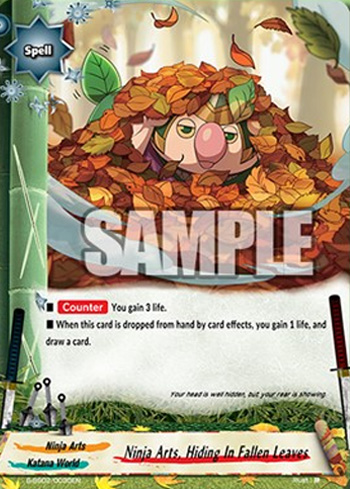
I miss jumping in leaves when I was a kid

Speaking of reprints, Fuuton, Sweeping Whirlwind was reprinted and with different art that was more themed around the Draninja deck. Another card that helps mitigate the hand loss is Ninja Arts, Hiding in Fallen Leaves except the player gains a life and draw instead of gauge and draw. The three life gain at counter speed could be used to mitigate damage during a battle.

Want a Pot of Greed at counter speed in the game? Because there is one for Draninjas! It's called Combats Rations -Gar-Rice-. Of course you need a Dragod monster on the field and a total power of 12,000 or more but that's not hard in Draninjas.

Last real solid card is Knives Ninja Technique, Ninbird. When a Dragod is called to the field, the player gains 2 life, discards a card from hand, check the top 3 card of their deck and put one to hand. The other two go to the bottom of the deck.

Keep in mind that the "tokens" that are spawned from Gargantua's Replicate count to Ninbird's effect requirement. That means Ninbird's skill could go off once during the player's turn and once during the opponent's turn. Then, don't forget Fuuton or Hiding in Fallen Leave's effects if they were discarded. You can see the nasty amount of filter and drawing that this deck can do by this point I hope.

Buddy Lineage is the last set currently that has any Ninja/Ninja Arts cards and it was only two cards. Flying White Moon, Tsukikage and Byakuya are interesting. They can both be viably used in either regular Ninjas or Garninjas.

Most of Garga's final forms require taking a card from the drop zone and putting it in his soul as a call cost if it's not called by G-EVO. This allows the player to give all ninjas 3,000 more power and 1 critical (Tsukikage) or immunity to effect destruction (Byakuya).

~Last updated 1/26/2019

Friday, December 14, 2018

Buddy Lineage Katana World Set Review


I love sets that give good support to older, fan favorite decks. Especially since the new cards effects help them stay relevant in the game. Sure, the below Katana World cards won't make any of the respective decks much higher tier than they already are but the old decks become fun to play with new cards.

This review will cover the Katana World reprints as well but won't be covered too much because... well... they're reprints. This article is actually relatively short compared to other articles since these cards are just support for pre-ace decks but let's have fun and see what combos we can think of!

Size 1

Magatsu Flames, Yamigitsune

He's back! And as a Secret Rare too!
My boy gets a new form! It's retrain of Companion Katana of Magatsu, Yamigitsune. The only difference in call cost between the two is Flames of Magatsu needs a Skull Warrior to be put in his soul which, let's be real here, is not hard at all. Especially with cards like Premature Passing, Bibikawazu and the myriad of ways to destroy your own Skull Warriors.

Flames of Magatsu, Yamigitsune's main ability is the following: When the player's Skull Warrior attacks and deals damage to the opponent, destroy the Skull Warrior. If you do, your opponent loses 1 gauge, 1 life and they discard a hand card. He also has double attack and soulguard so he can destroy himself twice during the battle phase.

Couple his abilities with Demon Way Arakuyou, you can plus real hard while you make your opponent suffer with no gauge or hand cards. It does seem that Bushiroad is trying to make normal advantage decks and anti-advantage decks which is a neat idea. Water already drains gauge real easily so Skull Warriors help join in in that aspect now.

Sadly, this doesn't mean Skull Warriors are going to be back in a high tier with just one new card but I've grown to accept it.

Soarspeed Moonglow, Tsukikage

I love that Tsukikage and Byakuya's cards are one picture

Next up is the ninja brothers making a return and giving us a reprieve from Garninjas. Tsukikage costs a life but that's fine. He lets the player search for Gojinmaru and add him to hand but the player must then discard a card. He also gives all other Ninjas 3000 power, 3000 defense and 1 critical if he's on the field or in the soul of a Ninja.

All in all, a new solid form that compliments the ninja brother deck quite well.

Soarspeed Moonglow, Byakuya

You can see Tsukikage's blade in the art from above

Of course there's no Tsukikage without his brother Byakuya. Soarspeed Moonglow, Byakuya also costs a life and has his standard shadow dive and discard a ninja art to restand effect. His last effect makes it so all ninjas can't be destroy by card effects if he is in the soul of a ninja.

This will help make Arc Particles Ghoul Deity, Gojinmaru last longer on the field before using his counter/act ability to call the souls to the field.

Funny enough, this could be used in Garninjas. When Gargantua Dragon, Wind Demon is called, you could put either Tsukikage or Byakuya from the drop into his soul to give him their effect. The effects help both decks which I think is pretty neat. Gives players options. Do they want to put a base form of Gargantua Dragon in Wind Demon's soul for the extra token or one of the ninja brothers for some extra effects?

Size 2

Flash of Purple Arc, Mikazuki-Munechika


Blade Beasts also get support! Finally their first card of the season! He's a little expensive with a 2 gauge call cost but that's understandable since you need to get Japanese Blade cards in the drop for his effect.

His main effect is quite wordy. At the beginning of the attack phase, if there are three or more different Japanese Blade in the drop, all Japanese Blades get Double Attack and Penetrate. Then, if there are five or more, for the turn, all Japanese Blades get 5000 power and 2 critical.

Again, these effects lasts for the whole turn. Even when the impact monster is called during final phase. 

Size 3

MRW I pull out my beat stick
Next is the new Kid Ibuki for Oni Assassins. It's pretty expensive at 2 gauge and a life but I can understand it. He does have triple attack and allows any Oni Assassin to gain 2 face down souls. Then, if he enters by ambush, your opponent has to drop (discard) a card. All these effects rightfully justify his cost. I just hope it's worth it. He seems more of an aggressive option instead of defensive and lets be honest. Most of the time, the souls are going to go into Kid Ibuki's soul anyways.

Overall, nice addition to the Oni line up but it won't change their play style much if at all.


Spells

About time it got a reprint!

I made a whole blog post about spell nullifies over here! That would be the best way to find out what I think about this card.

Super glad they're reprinting it since it was originally printed in set 2 and that was about four years ago. Before the reprint, the card was going for about 5-7 bucks each and it was an uncommon too! The game didn't have foil common, uncommon and rares when Sakurafubuki was first printed either so now it can be found foil. 

Takes two to tango

I don't feel that this one needed a reprint as well but they were reprinting several other multi-world spells in this set so that probably justified this card's reprint.

The card was used somewhat often back at the end of Hundred/beginning of DDD season but nowadays it's a little too slow for it to be as effective. Plus, more common cards are carrying the "can't be destroyed by card effects" clause. Making this card not as efficient either.

Friday, December 7, 2018

Impact! Triple Punisher Katana World Set Review


Finally after about 4 years, Katana World got a new pre-constructed deck release. Each deck is solid with great reprints within all three decks.

Within the Katana World deck, though, three cards were reprinted: Gargantua Dragon and Fuuton, Sweeping Whirlwind and Deity Gargantua Punisher as an SP rarity. Gargantua Dragon and Fuuton, Sweeping Whirlwind were needed because of the prices of these cards going higher and higher.

Gargantua Dragon was printed a lot in the Gargantua Awakened set which helped support both the Dragon World and Katana World releases but once Magic World Gargantua Dragon was announced, people were trying to pick up copies of him left and right which increased prices and at this point, he was decently hard to pick up.

Fuuton, Sweeping Whirlwind was only a box topper from the Driven to Disorder set. They were already highly valuable in the Tsukikage/Byakuya ninja decks. Deity Dragon Tribes coming to Katana World made them shoot up even more and it was just going to get even worse without a reprint.

Fuuton's reprint was great for two reasons. First, it came in a trial deck at a guaranteed two copies so people would only need to get two to have a play set. Second, the reprint has art more associated with Deity Dragon Tribes instead of the art with Electron Ninja, Shiden on it. I personally am a stickler for having appropriate art for the appropriate deck so I was ecstatic.

The cards in the deck help solidify Deity Dragon Tribe/Ninja support. The Dimension Destroyer support was a good start but it felt like some cards were missing to complete it and this pre-constructed deck will help.

Now before I get going, I want to mention something. Both Gargantua Dragon and his new variant Daybreak Roar, Gargantua Dragon are solid cards and they should be the main ones used in any variant of Deity Dragon Tribes. I'm mentioning this now because I'm not going real in depth below on them but wanted to assert that they are going to be the go-to variants and people don't have to search high and low for the other variants of Garga at this time for their decks to function.

Without further ado, let's analyse the (Katana World) cards!

Size 0:


Deity Dragon Low-Rank Ninja, Karakazemaru


First off the list is the two "maru" brothers. Karakazemaru is a size 0. His stats are 2000/1/1000. He's also free to call.

His first ability is if he is dropped (discarded) from hand, the play can gain a life and gauge. His second ability is just like boomerang dragon. After he attacks, the player returns Karakazemaru back to hand.

Karakazemaru will obviously work well in Garninjas because that's what he was designed for. However, he does help Japanese Blade/Blade Beasts as well. The deck can have a field of potentially size 1/2 or size 3/0 monsters on the field with one or multiple weapon(s) equipped and in either case, Karakazemaru can be played to the center and bounced back to hand without ruining the formation.

Within the game right now though, 2000 power and 1 critical aren't going to make any revolutionary changes. Sure it'll help the above mentioned decks a "little" bit but it won't pull up Blade Beasts from the tier 2/3 spot it's been in for the past several years.

Deity Dragon Low-Rank Ninja, Kogarashimaru


The second brother, Kogarashimaru, doesn't do nearly as much as Karakazemaru. Kogarashimaru has very similar stats which are 2000/1/2000 and he's free to call as well.

Kogarashimaru's on-enter skill allows the player to choose one Dragod monster in the drop zone and discard a hand card. If the player does discard a card, the player puts the Dragod to their hand.

This overall is suppose to be a wash (one card discarded to put a card in hand). However, at this point, it should be well known that certain cards in ninja decks let the player draw a card if they're discarded. I'll get to them soon but just take note that these cards allow players to occasionally plus from discarding by card effects.

Even though Kogarashimaru has the potential to be a plus 1, in nearly all situations, he won't be. This extends to further beyond than just his effect. The problem with Kogarashimaru is he's a size 0. Gargantua Dragon usually wants to start the attack phase with a size 1/2 field and spam the size 0 Dragod tokens mid-battle. That being said, Kogarashimaru will have to be called over to make the initial size 1/2 board state.

If a card like Fuuton, Sweeping Whirlwind is dropped for Kogarashimaru's effect and the player gains a plus one in card advantage, they're going to lose the Kogarashimaru by calling over him and sending him to drop.

This means in a less ideal situation without Fuuton, Sweeping Whirlwind, the player will be still minusing one. Since Kogarashimaru doesn't have the bounce effect like his brother, it's not like he can be called to the center and bounced back to hand.

The above problem is why he'll ultimately not be used in competitive Garninja decks. There's other more powerful options that don't minus the player.

Size 1:

Deity Dragon Ninja, Musashi


Musashi is an example of what I like to see in cards as far as the relationship between stats and abilities on the card. He has below average size 1 stats (3000/1/1000) but if you have a Dragod on the field, he gains two critical. This means he becomes above average for size 1 monsters. He also has the static "Shadow Dive" ability that allows him to attack the opponent directly even if there's a monster in the center.

Basically, well designed cards should have this dichotomy of sacrificing stats/resources to possibly gain advantage over the opponent. This isn't to say that this doesn't happen to a lot of Buddyfight cards because it absolutely does. He's just a more cut and dry example.

Regardless of this, he won't be used in decks. Sure, 3 critical is usually nothing to scoff at but when players can transform into cards that have well over 3000 defense, it struggles to actually hit the opponent. This kind of advantage (critical advantage in this case) isn't normally sought after by competitive players because it's easy to work around and doesn't have any lasting effect on the board state after the battle phase ends.

Battle Dog Under the Moon, Nindog


My man Nindog is back with a new form. Nindog's stats are 3000/2/1000. He's only down 1000 base stats from a vanilla size 1 Katana World monster which is good. His one ability is when he enters the field, put the top card of the player's deck into their gauge for each Deity Dragon Tribe monster on the field.

Keep in mind this includes himself so the player will always get at least one gauge. With the size 0 monsters in the set, the player could get up to 3 gauge when he enters the field.

Unfortunately, there are better size 1 options and I still prefer the original Nindog more to just add more copies of itself to the hand. Sure, the cards added to the hand don't do anything but Nincat and other cards are there to freely discard the copies to get "real" cards. Plus, Nindog helps thin the deck for consistency.

Flash of Momiji, Nincat


Onto the Nincat in the deck! Flash of Momiji, Nincat is free to call as well. His stats are 3000/2/1000. His ability is when it attacks, the player chooses up to two Ninja from the drop zone with different card names and drop a hand card. If a hand card is dropped, add the two cards back to the player's hand.

One of the purposes of this card is to grab a Katana World Gargantua Dragon form to G-EVO into during the battle phase and, just like with other discard effects possibly plus one more with Fuuton, Sweeping Whirlwind. Otherwise, the effect is a plus one (discard one card to gain two cards).

The problem with this card is it's slow. It would be a more preferred ability if it could be activated during the main phase, like an on enter ability, to help the player properly set up their board but this card won't help to that end... unless you want to wait until the player's next turn.

Knives Ninja Technique, Ninbird


Well, here we are. Reviewing another Bird form. Contrary to his other Dragon World and Katana World forms though, this one is actually solid. Knives Ninja Technique, Ninbird has 4000/1/1000 stats and he's free to play. However, only one can be played once per turn.

His ability is when a Dragod enters the field, the player may drop a hand card and if they do, the player gains 2 life, check the top three cards of the deck and put one from among them into your hand. The rest go to the bottom of the deck. This ability is a soft once per turn.

Bushiroad must've noticed people running Guardian Electrobeast, Goryou and wanted to curb the need for the card in Garninjas.

Since Ninbird is during the main phase, this card helps get the field set up. The player can possibly get their item or get Art of Truancy and make their board safer. The card states that any card can be grabbed with the effect so the player doesn't have to reveal the card to their opponent.

Size 2:

Gargantua Kirigakure Dragon


Onto the proverbial "meat and potatoes" of the deck. The Gargantua Dragon forms! First up is Gargantua Kirigakure Dragon. He has the standard 6000/2/6000 stats of other Katana World Gargantua Dragon forms.

His call cost is pay 2 gauge and put the top card of the player's deck into his soul. This is an odd call cost compared to his earlier forms. His earlier forms costed 1 gauge and put a card from the drop into his soul. This helped Gargantua Dragon get the G-EVO card in his soul to help get his form's full ability going.

Kirigakure Dragon has move and soulguard. When he enters the field, put up to one Ninja Arts from the player's deck into their hand and shuffle the deck. Then, if it entered by G-EVO, the player gains 2 life and deals 2 damage to the opponent.

The effect is quite flexible since G-EVO activates at the end of a battle with a base Gargantua Dragon. The newer form of Gargantua Dragon has move and soulguard so the player could G-EVO into Kirigakure dragon during the opponent's battle phase and search for a Ninja Arts that could help with defend during the battle phase.

Or it could go the traditional route and grab a Ninja Arts card that will help push for game such as Hades Flame Style, Art of Fire Manipulation or Deity Dragon Ninja Arts, Cy-clones Sword Dance.

Gargantua Jiraiya Dragon


The second Gargantua Dragon form in the trial deck is... okay I suppose. Jiraiya Dragon has the standard 6000/2/6000 stats. His call cost is put a card from the drop zone into his soul and pay 2 gauge. This is going back to the original, better call cost but unlike Garga's Dimension Destroyer variants, it's 2 gauge instead of 1.

Jiraiya Dragon has move and soulguard. When it enters the field, the player may pay 1 gauge. If they do, put up to two cards from the top of their deck face down on the field as "<<Dragod>>/size 0/6000 power/6000 defense/ 2 critical" monsters. Jiraiya also gives all monsters on the field +3000 power and +1 critical if he has a card with G-EVO in his soul.

The problem with Jiraiya is he's competing with Gargantua Wind Demon Dragon which is objectively better. Sure, the extra power and critical to all the monsters is nice. I won't deny that but Wind Demon Dragon helps summon tokens during both players turn to help with both offense and defense.

Jiraiya is only upon entering the field and the player has to pay a gauge to call the clones. Meaning he costs more and is limited in the situations where he excels. Sure the gauge costs is probably justified because of the bonus stats the tokens can receive but good players can usually work around generic aggressive cards.

On top of that, the on-enter token creation can cause the player to waste or lose attacks with the initial size 1 that would already be on the field and the weapon. Wind Demon Dragon is a Counter/Act ability so the play can choose when the appropriate time is to summon the tokens.

The player could probably hit with the size 1 and item if Gargantua Dragon and his Wind Demon form could destroy enough cards in the center of the field. Then, the size 1/item could attack the player. Once the size 1/item have attacked, the player could call the tokens to the field. The way Jiraiya is, the player would lose the size 1/item if they needed the extra attacks from Jiraiya to break through the center.

I know this sounds like a nit-picky situation but this can occur pretty frequently. Especially if the opponent is aware of this crux.

Spells:

Fuuton, Sweeping Whirlwind


So this isn't the first time Fuuton, Sweeping Whirlwind has been printed but it is a staple card for the ninja decks and it needed a reprint. The first time it was printed, it was out of Driven to Disorder as a box topper. I didn't review it during that post because we weren't 100% sure if it was coming out until the English version of the set came into consumer's hands and at that point, I already released the set review.

I wanted to touch upon this card because it touches upon a core concept of card games that all players should be aware of if they want to have any chance have being good at any card game. That concept is called Card Advantage.

Card advantage is a game action that either generates more quantifiable benefits or resources to you than it costs. Card advantage is a good indicator of the status of the players within the game and could indicate who is going to win said game. The logic being if someone has more cards than their opponent, then they possibly have more ways to either not lose the game or push hard enough to win the game.

Card advantage is applied to both the cards on each player's field and in each player's hand and is usually referred to as "plusing", "minusing" or "going even". For example, when someone plays a card on the field from their hand, it's considered minus one from the hand but a plus one to the field which means the player is going even.

The power of Fuuton, Sweeping Whirlwind is the case that the player can virtually never minus with the card when it's played in a ninja deck. Let's look at Fuuton's abilities and see what I mean.

Fuuton's first skill allows the player to put a Ninja from their drop into their hand. The player is minusing one for casting the spell but gains a plus one for adding a Ninja back to their hand. This is considered going even where no net gain of cards was achieved.

Fuuton's second skill allows the player to gain a gauge and draw a card if Fuuton gets discarded from hand by a card effect. Ninja cards are full of effects that include discarding in order to either draw cards from deck or gain back cards from the drop zone. This discarding is meant to curb the hand advantage that could get out of control.

Fuuton helps bypass this loss of hand cards by not only allowing the player to draw a card but gain a gauge that could help them call/cast/equip cards that are in their hand that they drew into.

To clarify this, let's look at only Art of Getting Fish's second effect which states the following:

Put up to a total of two Deity Dragon Tribe monsters or items with different names from your drop zone into your hand. If you put two cards, drop a hand card.

Let's go through the process one step at a time:

  1. The player casts Art of Getting Fish (-1 card. -1 overall advantage)
  2. The player grabs two cards from the drop and adds them to hand (+2 cards. +1 overall advantage)
  3. Since the player grabbed two cards, they must drop a card from hand (-1 card. 0 overall advantage)
Art of Getting Fish is balanced in the sense that there is no net gain of cards in hand or field for the player. Let's say the player discards Fuuton, Sweeping Whirlwind in step 3. Then, Fuuton will activate in a "step 4", if you will, and the player will gain a gauge and draw a card (+1 card. +1 overall advantage).

I know only gaining one overall card advantage doesn't sound crazy but when you apply this to other cards and combos decks can do, it can accumulate a lot of cards and give you, the player, an edge over the opponent. There is more to card advantage but I wanted to talk about the aspect of it in relation to Fuuton, Sweeping Whirlwind.

In Buddyfight, there is also life and gauge as a resource but I won't get into those right now. The core concept to understand is card advantage at the moment and make sure you understand it well.

Ninja Arts, Hiding in Fallen Leaves


This next card can help with card advantage as well. Ninja Arts, Hiding in Fallen Leaves has two abilities. At counter speed, the player can gain 3 life.

This is nice for when the opponent is trying to close out the game with an impact. The 3 life gained can help keep the player from losing. Many impacts state that the impact can't be nullified, the damage can't be reduced or the player can't be revived. Hiding in Fallen Leaves gets around all of this because the player is just gaining life points. However, going with the card advantage from above, this is a minus one since you're discarding a card and gaining no cards in return. Normally this could be seen as bad but if you need to lose a card to stay in the game, it is probably worth it.

Hiding in Fallen Leave's second ability is the better of the two effects. When it gets dropped from the hand by card effects, the player gains 1 life and they draw a card. It's just like Fuuton's discard effect except you gain a life instead of a gauge. This makes it as a solid back up to Fuuton and I could see it being played probably around 2-3 since the first effect isn't as ideal to Fuuton's first effect.

Deity Dragon Fuuton, Gale Blade


Deity Dragon Fuuton, Gale Blade is also playing into the discarding effects of Garninjas and card advantage. Let's review each of it's effects one at a time and see how it is in relation to card advantage.

The first effect, at counter speed, allows the player to return a size 2 or less monster or spell on the opponent's field to hand. Players may initially think this is going even because the player is losing Fierce Wind Blade to have the opponent lose a card on the field but you must look one step further.

The card is returning to the opponent's hand. Sure, the card is minus 1 on the field but it's a plus 1 back to their hand. Mean while, the player loses Fierce Wind Blade for casting it; Making it a minus 1 for the player.

So you, the reader might wonder why you would use this card's first effect. The fact of the matter is that cards like this may make you minus 1 but it can give you what's called tempo against your opponent. Bouncing a monster or spell that would cause a lot of damage can give you the edge you need to survive this round and win next round.

The second effect only activates if the card is dropped from hand by a card effect. The player pays 1 life and can bounce any card back to hand. Again, there is no hand advantage to be made since it's being discarded and you're only shifting the card from field back to hand but there's a lot of cards that can't be destroyed by card effects. Returning cards to hand can give that edge you need against certain decks.

Combat Rations -Gar-Rice-


Gar Rice (as I'm going to call it) is a solid draw spell. It is a great, simple example of a plus one in card advantage. The player plays Gar Rice (-1) to draw two (+2. +1 overall advantage). I know I'm really beating this proverbial horse but I want to emphasize what main concept is taken the most into consideration when looking at cards and building Garninjas correctly.

It's also good to note that this card is at counter speed. If the player can't get a Dragod monster on the field with total power of cards on the field being 12,000 or more, they can probably get it when the tokens are called to the field. Sure it's slower than playing it during the main phase but it's better than nothing at all. This card is also why I still prefer the original Nindog compared to the trial deck variant. Original Nindog has 6000 power.

Deity Dragon Doton, Cliff-Splitting Wall


Cliff-Splitting Wall is a new shield for Garninjas. It can only be casted if there is a Deity Dragon Tribe on the field during an attack on the opponent's turn. Nullify the attack, then the player may drop a hand card. If you do, gain 2 gauge and draw a card.

Like most shields, and regardless of it's secondary effect, it's a minus one to hand advantage but that's not a bad thing. Shields aren't really valued for their card advantage. They help the player stay in teh game. The secondary effect is naturally going even so if you have a duplicate item in hand or a second Art of Truancy in hand, by all means ditch it to gauge 2 and draw a card. At this point it should be obvious but the two best cards to discard are either Fuuton, Sweeping Whirlwind or Ninja Arts, Hiding in Falling Leaves.

Items:

Deity Dragon Wristguard, Gar-Claw


Moving onto the items now, the first one is Gar-Claw. It has 6000/2 stats and costs a gauge and life to equip. The claw has double attack and if there is a Dragod on the field, all of the player's monsters can't be destroy by the opponent's card effects.

Between the two trial deck's items, I prefer this one over the next item card. The anti-destruction is always a welcome sight to see and it has 6000 power. Making it easier and require less cards to get Gar Rice off.

Deity Dragon Kodachi, Gar-Tsubaki


Gar-Tsubaki has 4000 power and 2 critical. It costs 1 gauge to equip it. It's similar in effect to Deity Dragon Blade, Garkunai. Gartsubaki states if the player is being attacked, they may drop a hand card. If they do, for the turn, the next time the player would be dealt damage it is reduced by 3 and it's a soft once per turn.

Instead of nullifying the attack like Garkunai, it reduces damage received. I would rank Garkunai higher than Gartsubaki because Garkunai's ability isn't once per turn.

Impacts

Deity Gargantua Punisher!! (Katana World)


I already reviewed this card in the Dimension Destroyer Katana World set review which you can read here! Just scroll down a little ways.

Otherwise, it's cool to see another SP foiling of a card. I love the gold border SPs so I fully welcome this card into my collection but it probably won't be used...

Deity Dragon Ninja Arts, Multiblade Whirlwind


As if one impact wasn't enough for the trial deck, Bushiroad had to add a second one. Whirlwind Blades requires the opponent to have 5 life or less and have a Dragod on the field. It costs 2 gauge to play. It deals 2 damage plus the number of monsters on the player's field with 6000 power or greater and the damage cannot be reduced.

I could see people trying to work it into their decks. I probably won't run this but, it objectively is better than Deity Gargantua Punisher for several reasons.

First, the casting requirement is less than Deity Gargantua Punisher. Whirlwind Blades only needs a Dragod on the field and the opponent at 5 or less life.

Second, given that the cast cost is less, the same amount of damage can be potentially done.

Third, but I believe is most important, it's a Ninja Arts attribute card. Meaning it can be tutored with Gargantua Dragon's Kirikagure form, Secret Scrolls or put underneath Shinobi Scrolls and still be casted. It can also be grabbed by Apex of Flashstep, Tsukikage from the drop if you so choose to do so.

Now people may say that it's possible for the opponent to destroy the tokens at counter speed to deal less damage to the opponent when the player casts this impact and you may be right. However, if the opponent did have such a card, they will probably use it during the battle phase to lessen the effectiveness of the attack phase instead of during the final phase.

-----------------------------------------------------------------------------------------------------

So that's that. I hope the card advantage part was informative to some people newer to card games. Normally I don't bring it up too much but with all the discarding done in the deck, I wanted to put it out there and have people be aware of if they're losing or gaining cards in hand.

Let me know if you have any questions. I feel deck building Garganinjas is a little more complicated than usual now and there's actually a couple different play styles you can play around with.